 Zerolimits
Battle ropes
Battle ropes are a conditioning exercise where you move both ends of a heavy anchored rope to make waves or slams. They mainly work your shoulders and core, and they build work capacity and arm power with no impact on your knees.
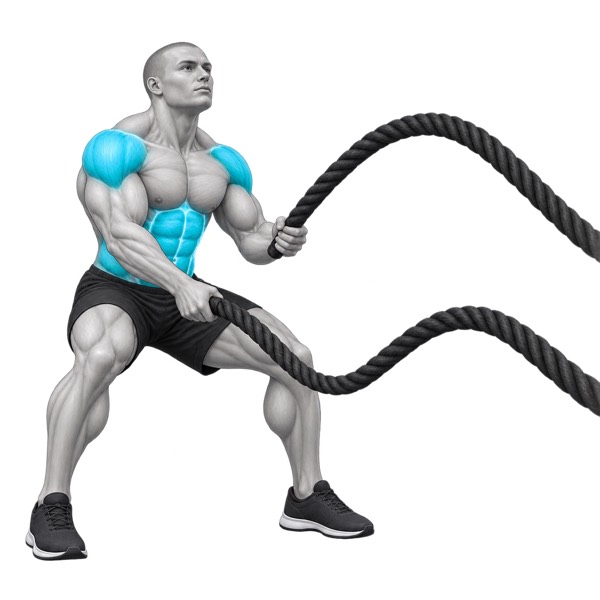
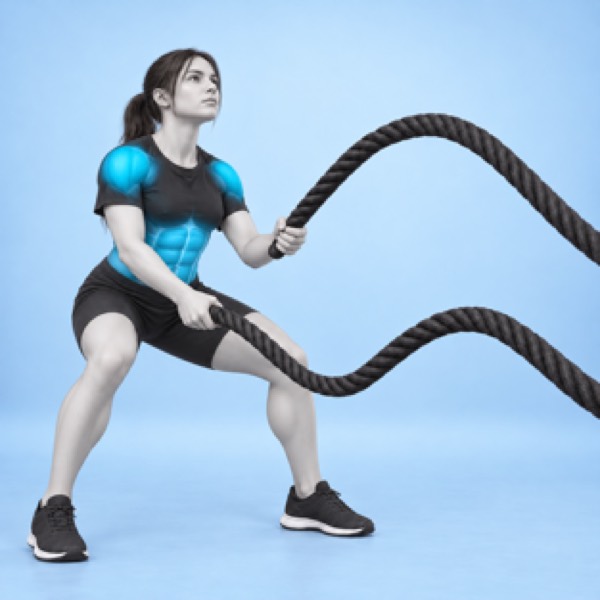
- Primary muscle
- Shoulders
- Also works
- Core
- Equipment
- Functional
- Pattern
- Conditioning
Muscles worked
Your front and side delts do most of the work, raising and lowering your arms nonstop. Your biceps, triceps and forearms hold the grip and the rhythm. Your core, abs and lower back, keeps your trunk solid while the rope pulls on you, and your quads and glutes hold the half squat. In slams, your arms go overhead and your lats and abs work harder as you drive the ropes down.
How to do it
Setup
- Loop the rope around a solid anchor at its midpoint, so both ends are the same length.
- Grab one end in each hand, thumbs up, and step toward the anchor until the rope has some slack.
- Sink into a half squat: feet shoulder-width apart, knees bent, chest up, abs braced.
Execution
- For alternating waves, raise and lower each arm in turn, fast, from hip height to chest height.
- Drive your arms from the shoulders with enough amplitude that the waves travel all the way to the anchor.
- For slams, lift both ropes overhead together and whip them into the floor, sinking a little deeper into your knees.
- Hold the half squat and breathe in rhythm for the whole interval; your torso doesn't rock.
Key cue: Make the waves from your shoulders, with your torso still and your knees bent.
Common mistakes
- Standing up with straight legs. Your lower back ends up absorbing every wave. Stay in the half squat even when you tire.
- Making small waves that die halfway down the rope. You're only moving your hands. Use your whole arm until the waves run the full length.
- Going all out and gassing in 10 seconds. Find a pace you can hold for the whole interval with the same wave size.
- Standing with the rope pulled tight. With no slack, no waves form and you just tug on the anchor: take a step forward.
Variations
- Double waves: Both arms rise and fall together. More power per wave and more work for your core.
- Slams: Lift the ropes overhead and drive them hard into the floor. Your lats, abs and legs work harder.
- Circles: Make circles with your arms, inward or outward. More shoulder work and less leg work.
Sets and reps
They work best as short intervals: 20–30 seconds at a hard pace with twice as much rest. For time or distance: 3–4 rounds. Once you finish every round with good form, add load, distance or difficulty.
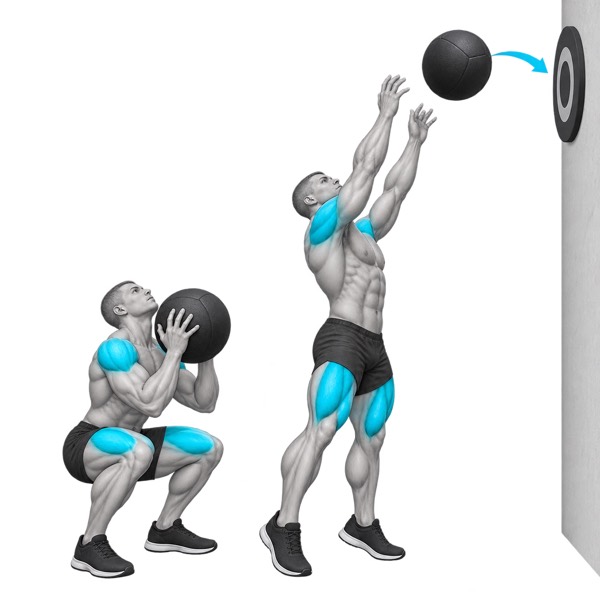
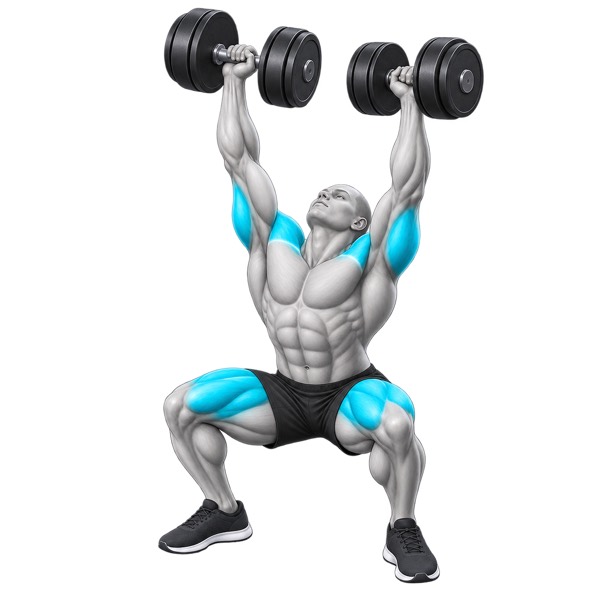
Alternatives
Frequently asked questions
What muscles do battle ropes work?
Mainly your shoulders and core. Your arms and forearms hold the grip, and your legs and glutes hold the half squat for the whole interval.
Do battle ropes build muscle?
Not much. The load is light and the effort is continuous, so they build endurance and work capacity more than strength or size. Use them as conditioning at the end of a session, not in place of your strength work.
What size battle rope should I use?
For most people, 40–50 ft long and 1.5 inches thick. A 2-inch rope is heavier and harder to grip. The longer and thicker the rope, the heavier it is and the harder it is to keep the waves going.
How long should you do battle ropes?
Intervals of 20–30 seconds with 40–60 seconds of rest. Stop when you can't keep the waves the same size. Five to 10 minutes of total work at the end of a session is plenty.