 Zerolimits
Kettlebell snatch
The kettlebell snatch takes the bell from between your legs to overhead in one movement, with one arm. It's a one-arm swing that finishes overhead: it mainly works your glutes, hamstrings and shoulders, and it demands technique, hip power and a solid grip.
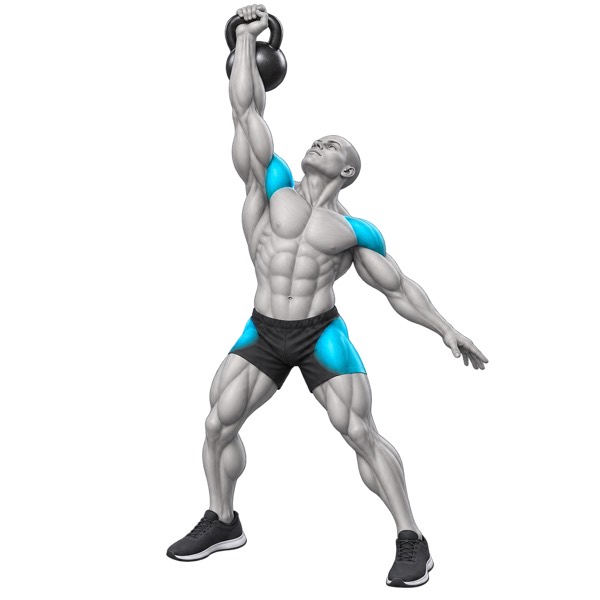
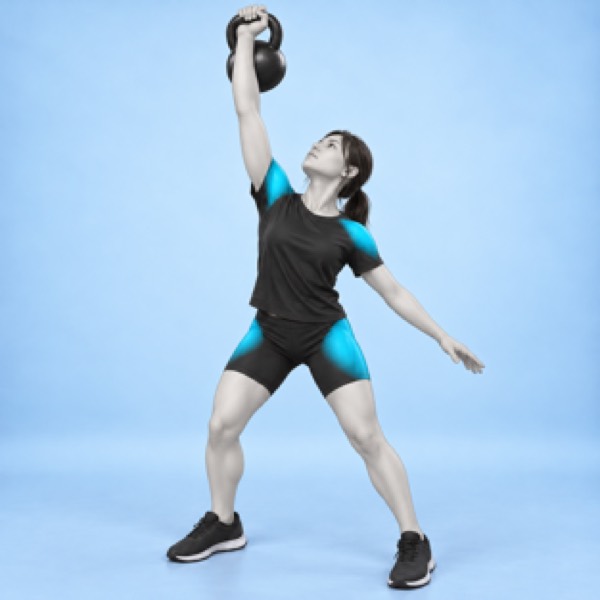
- Primary muscle
- Shoulders
- Also works
- Glutes, Hamstrings, Core
- Equipment
- Kettlebell
- Pattern
- Hip hinge
Muscles worked
Your glutes and hamstrings produce almost all the force with a hard hip snap, like in a swing, while your spinal erectors hold your back neutral in the hinge. Your traps and delts guide the bell close to your body on the way up, and your rotator cuff, delts and triceps stabilize it with your arm locked out. Your core resists the rotation of a one-sided load, and your forearm holds the handle on the drop. Your quads do little, because your knees barely bend.
How to do it
Setup
- Set the kettlebell on the floor about a foot in front of you, feet shoulder-width apart.
- Hinge at the hips with a neutral back and grab the handle with one hand; your other arm stays free.
- Hike the bell back between your legs, high and close to your groin, like the start of a swing.
Execution
- Snap your hips forward, squeezing your glutes, and let the bell float up close to your body.
- As it passes your chest, let your elbow bend up to keep it close to your face instead of swinging it out in a wide arc.
- Around head height, punch your hand through the handle and straighten your arm: the bell rotates around your hand and settles softly on your forearm.
- Lock out for a moment, biceps by your ear. To come down, let the bell drop close to your body and catch it with your hips back, between your legs.
Key cue: Your hips launch the bell; your arm just guides it close.
Common mistakes
- Banging your forearm at the top. It happens when the bell travels in a wide arc and flips over your hand. Keep it close and punch through the handle before it gets to the top.
- Lifting it with your shoulder. If your arm rises straight like a front raise, your shoulder tires and your hips stop working. The power comes from your hips.
- Squatting instead of hinging. Bend your knees too much and the bell hits them. Push your hips back and keep your shins close to vertical.
- Death-gripping the handle the whole time. That's how calluses tear. Grip firmly at the bottom and loosen your hand slightly as you punch through at the top.
Variations
- One-arm swing: The same hip snap without going overhead. Master it before you move to the snatch.
- Half snatch: Same way up, but you lower the bell to the rack position by your chest first, then between your legs. Easier on your hands.
Sets and reps
It works well in sets of 6–10 per arm; end the set when the bell starts drifting away from your body. To build muscle and strength: 6–12 reps, 3–4 sets. When you complete the range on every set, add a little weight. That's double progression.
Alternatives
Frequently asked questions
What muscles does the kettlebell snatch work?
Mainly your glutes and hamstrings, which produce the power, and your shoulders, which stabilize the bell overhead. Your upper back, core and grip work hard too.
Kettlebell snatch vs swing: what's the difference?
The swing ends at chest height with your arms straight. The snatch keeps going overhead with one arm, asks more of your shoulder and your technique, and the drop is harder on your hands. Learn the swing first.
What kettlebell weight should I start snatching with?
One you can swing smoothly with one arm and press overhead with that same arm. For many people that's 18–35 lb. If you can, learn it with a coach.