 Zerolimits
Plank
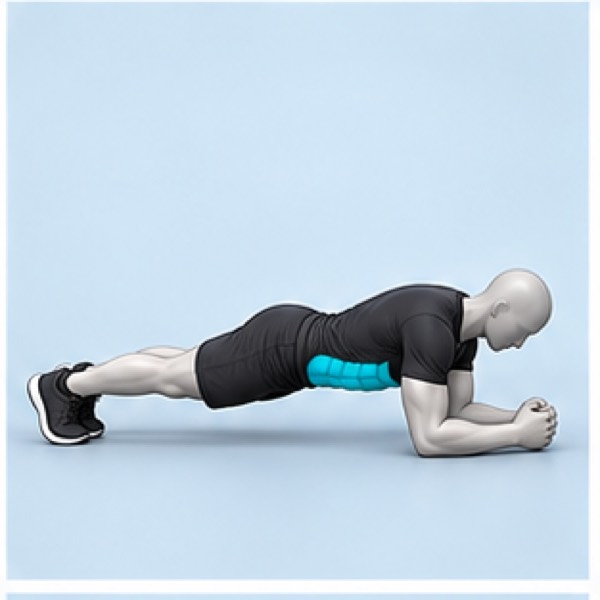
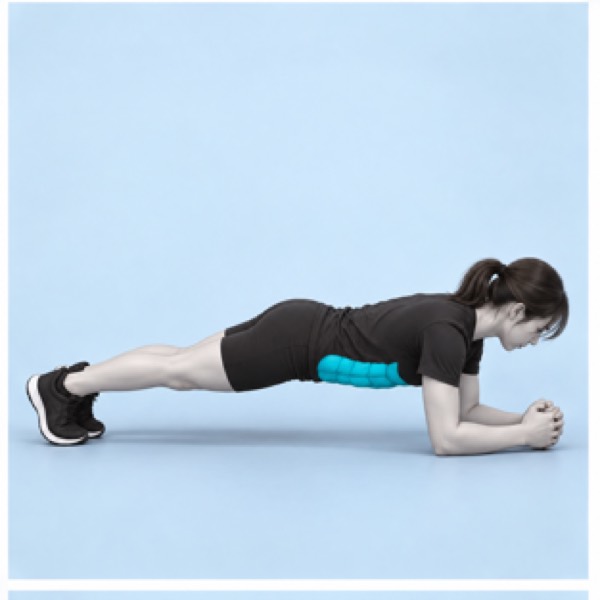
The plank is an isometric exercise where you hold your body straight on your forearms and toes, and it mainly works your rectus abdominis and transverse abdominis, which keep your hips from sagging. Your obliques, glutes and shoulders help. It's also called a forearm plank or front plank.
- Primary muscle
- Core
- Also works
- —
- Equipment
- Bodyweight
- Pattern
- Core stability
Muscles worked
Your rectus abdominis and transverse abdominis hold your trunk so your lower back doesn't arch, with help from your obliques. Your glutes keep your hips extended and your quads lock your knees. Your shoulders and serratus support your upper body. If you squeeze your glutes as hard as you can and pull your elbows toward your feet without moving them, your abs work far harder than in a relaxed plank: that's the RKC plank.
How to do it
Setup
- Place your forearms on the floor with your elbows directly under your shoulders.
- Extend your legs back, feet hip-width apart, on the balls of your feet.
Execution
- Tuck your pelvis slightly and squeeze your glutes and abs.
- Line up your head, back and hips, eyes on the floor, without piking your hips up or letting them sag.
- Push the floor away with your forearms so your upper back doesn't sink between your shoulder blades.
- Take short breaths without relaxing your abs, and hold until your position starts to break.
Key cue: Squeeze your glutes and abs so your hips neither sag nor pike.
Common mistakes
- Letting your hips sag. Your lower back arches and the tension moves from your abs to your back. When that happens, end the set.
- Piking your butt up. It makes the plank easier. Aim for a straight line from shoulders to ankles; a mirror or a video helps.
- Holding for minutes with sloppy form. More time doesn't make up for a loose plank. After 60 clean seconds, make it harder, not longer.
- Holding your breath. Take short breaths with your abs braced; if you can't, the variation is too hard for you.
Variations
- Side plank: On one forearm, side-on, with your body straight. It works your obliques and quadratus lumborum more.
- RKC plank: A short, very tense plank: glutes squeezed as hard as possible and elbows pulling toward your feet. 10–20 seconds is plenty.
- Plank with arm or leg lift: Lift one arm or one leg without your hips rotating. Your obliques work harder to keep you square.
Sets and reps
Hold 20–60 seconds per set; if you pass 60 without shaking, switch to a harder variation instead of holding longer. For time or distance: 3–4 rounds. Once you finish every round with good form, add load, distance or difficulty.
Alternatives
Frequently asked questions
What muscles does the plank work?
Mainly your rectus abdominis and transverse abdominis, which stop your lower back from arching. Your obliques, glutes, quads and shoulders also work to hold the position.
How long should you hold a plank?
20–60 seconds per set, for 3–4 sets, with perfect form. Holding for several minutes doesn't add much: past a minute, a harder variation such as the RKC plank or a plank with a limb lifted does more.
Do planks give you visible abs?
Planks make your abs stronger, but whether your abs show depends mostly on your body fat, not on how long you hold a plank. To grow the muscle, pair planks with loaded exercises such as cable crunches.