 Zerolimits
Preacher curl
The preacher curl is a barbell curl with the backs of your upper arms braced on an angled pad, and it mainly works your biceps brachii and brachialis. The pad takes away any swing and makes the bottom of the rep the hardest part. It's usually done with an EZ bar and is also called the Scott curl.
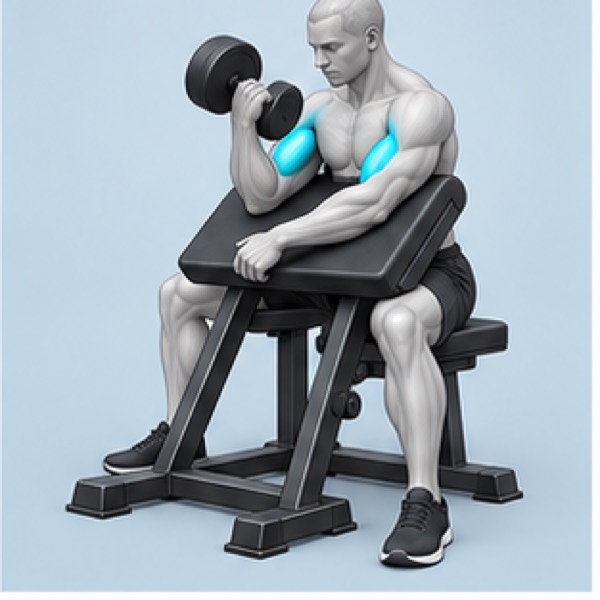
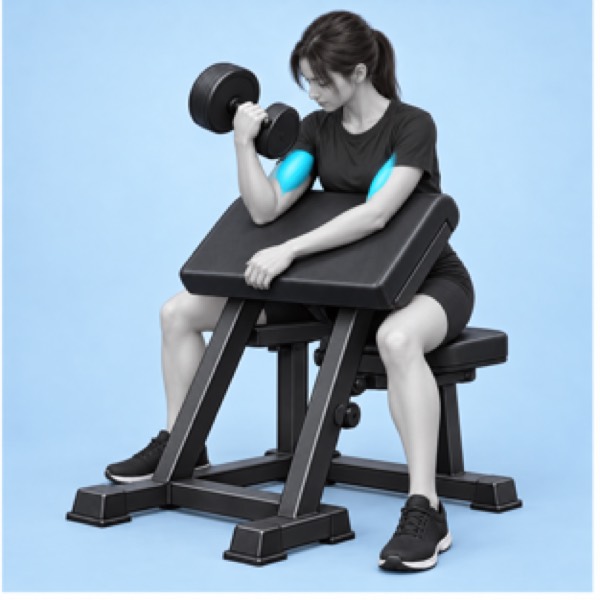
- Primary muscle
- Biceps
- Also works
- —
- Equipment
- Barbell
- Pattern
- Elbow flexion
Muscles worked
Your biceps brachii and brachialis do nearly all the work, and the brachioradialis helps. With your arms in front of your body, the long head of the biceps is slightly shortened at the shoulder, so the short head and brachialis take a bigger share. On a 45° pad the hardest point comes with your arms almost straight; near the top, the tension nearly disappears.
How to do it
Setup
- Set the seat so your armpits sit on the top edge of the pad and the backs of your upper arms lie flat on it.
- Grip an EZ bar on the inner angled grips, palms up and turned in slightly.
Execution
- Start with your arms almost straight, without snapping your elbows locked.
- Curl the bar up by bending your elbows, keeping your arms flat on the pad.
- Stop when your forearms are close to vertical; beyond that the tension drops off.
- Lower over 2–3 seconds until your arms are almost straight, and start the next rep without bouncing.
Key cue: Control the bar all the way down and never bounce out of the bottom.
Common mistakes
- Bouncing at the bottom with straight arms. That's where your biceps are most loaded and stretched, and where the tendon takes the most stress. Slow down before you get there and curl up without a bounce.
- Setting the seat too low or too high. If your armpits don't reach the edge, your arms don't lie flat and your shoulders start pushing. Adjust the height before you load the bar.
- Lifting your elbows or getting off the seat to finish the rep. If your arms leave the pad, the weight is too heavy.
- Only doing the top half. That's the easy part. Lower until your arms are almost straight on every rep, even if you have to drop weight.
Variations
- Dumbbell preacher curl: One arm at a time. Each arm works on its own, and you can do it over the back of an incline bench if your gym has no preacher bench.
- Machine preacher curl: The path is guided and the resistance is often spread more evenly, with tension at the top too.
- Straight bar preacher curl: Your palms face fully up: a bit more biceps, but more stress on your wrists.
Sets and reps
8–15 reps works well; here a slow lowering matters more than the weight on the bar. To build muscle and strength: 10–15 reps, 2–4 sets. When you complete the range on every set, add a little weight. That's double progression.
Alternatives
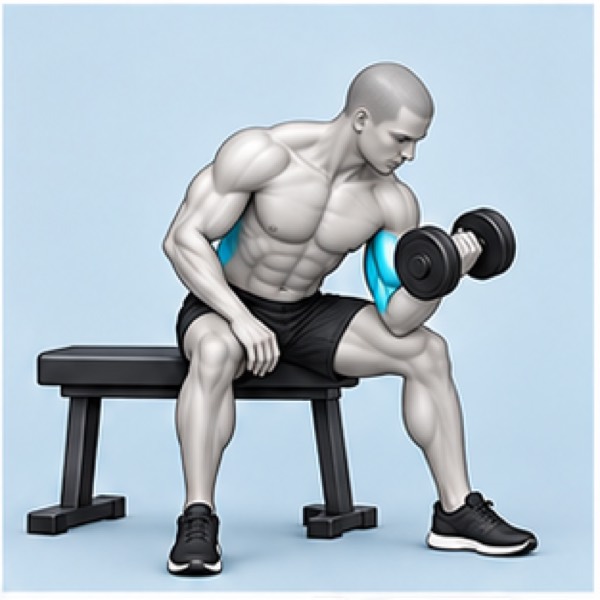
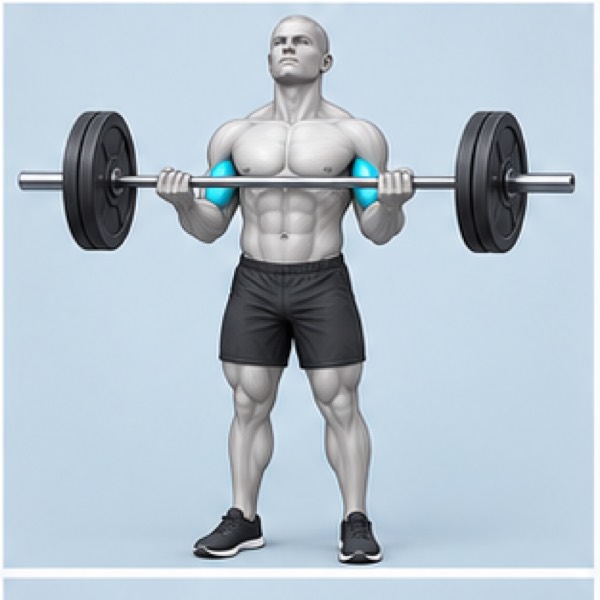
Frequently asked questions
What muscles does the preacher curl work?
Mainly your biceps brachii and brachialis, with help from the brachioradialis. Because your arms are braced in front of your body, the bottom of the range is the hardest part.
Why is it called a preacher curl?
The angled pad looks like a preacher's lectern. It's also called the Scott curl after Larry Scott, the first Mr. Olympia, who made it famous in the 1960s.
EZ bar or dumbbell for preacher curls?
An EZ bar lets you lift more and keeps your wrists comfortable. A dumbbell works one arm at a time and helps fix side-to-side differences. If you only do one, the EZ bar is easier to progress.