 Zerolimits
L-sit
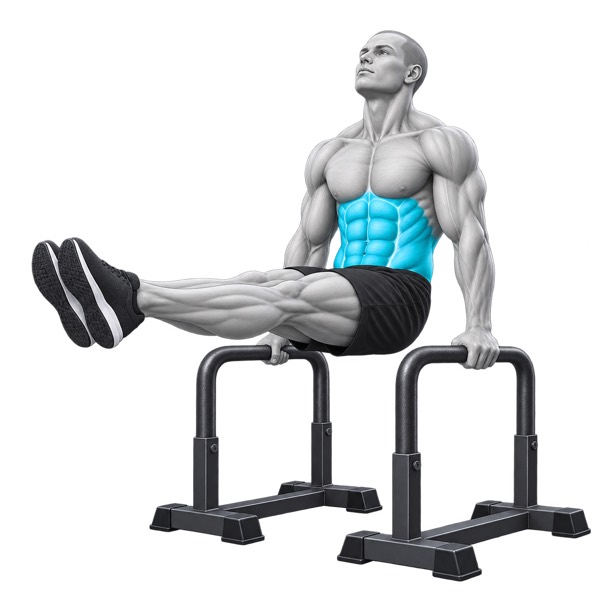
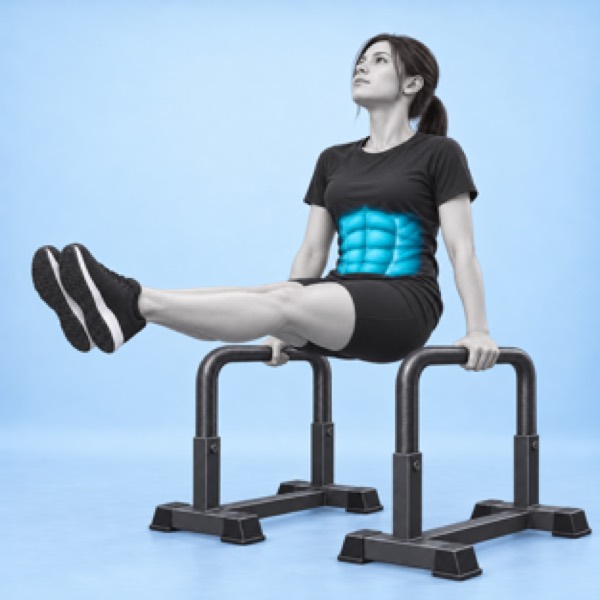
The L-sit is an isometric hold where you support yourself on straight arms with your legs straight and parallel to the floor, making an L shape, and it mainly works your rectus abdominis and hip flexors. Your triceps and shoulders also work hard to keep you up.
- Primary muscle
- Core
- Also works
- —
- Equipment
- Bodyweight
- Pattern
- Core stability
Muscles worked
Your hip flexors (iliopsoas and rectus femoris) hold your legs at hip height, and your quads keep your knees locked. Your rectus abdominis and transverse abdominis tuck your pelvis slightly so your legs don't drop. Your triceps lock your elbows, while your lats, pecs and lower traps push your shoulders down. With your knees tucked, the lever is shorter and the hold is much easier.
How to do it
Setup
- Use parallel bars, parallettes or two sturdy hex dumbbells; the floor version is harder.
- Place your hands next to your hips, fingers pointing forward and arms straight.
Execution
- Push down until your elbows lock and your shoulders move away from your ears.
- Lift your legs together and straight until they're parallel to the floor, toes pointed.
- Hold the position with short breaths, abs tight and shoulders down.
- Stop when your feet drop below hip height or your shoulders start to shrug.
Key cue: Push your shoulders away from your ears, lock your elbows and keep your knees straight.
Common mistakes
- Shrugging. If your shoulders creep up to your ears, you lose strength and load your neck. Push down as if you were trying to grow taller.
- Letting your knees bend without noticing. That's a different, easier variation. If you can't hold straight legs, do the tucked version on purpose and time it separately.
- Letting your legs drop. The L is gone once your feet sink below hip height; end the set there.
- Starting on the floor. With your hands on the floor you have less clearance and need more compression. Learn it on parallettes or dip bars first.
Variations
- Tuck L-sit: Knees to your chest, feet off the floor. The first step: hold 20–30 seconds before you straighten your legs.
- One-leg L-sit: One leg tucked and the other straight, alternating each set. The bridge to the full L-sit.
- V-sit: Your legs rise above horizontal. It takes a lot of compression strength and hamstring flexibility; only try it once you can hold a 30-second L-sit.
Sets and reps
Do 3–4 sets of 10–30 second holds; once you hit 30 seconds on every set, move to a harder variation instead of holding longer. For time or distance: 3–4 rounds. Once you finish every round with good form, add load, distance or difficulty.
Alternatives
Frequently asked questions
What muscles does the L-sit work?
Mainly your rectus abdominis and hip flexors, which hold your legs up. Your quads lock your knees, and your triceps, lats and shoulders keep you supported.
How do I start doing L-sits?
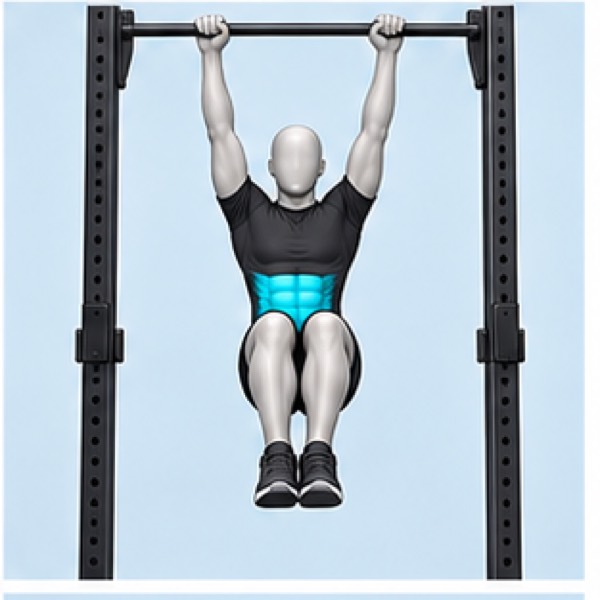
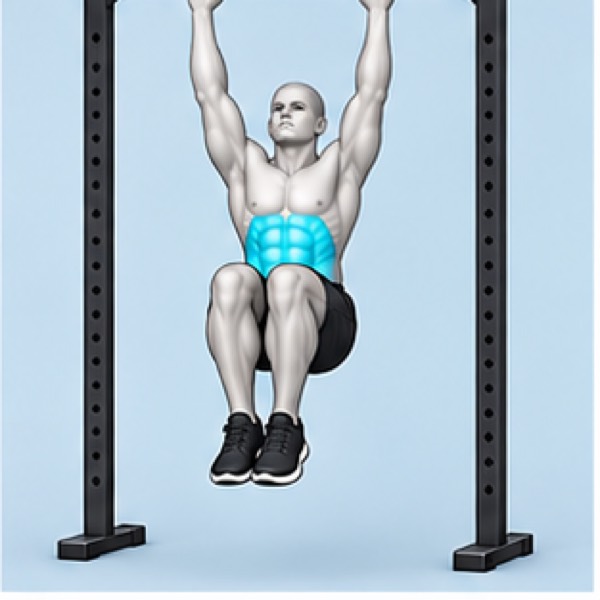
Start on parallettes or dip bars with 10-second holds, shoulders down and knees tucked. Once you can hold 20–30 seconds, straighten one leg, then both. Hanging leg raises help build the strength you're missing.
Why can't I straighten my legs in an L-sit?
Usually two things: hip flexors that are weak when your legs are already high, and tight hamstrings. Train seated leg lifts on the floor and stretch your hamstrings. In the meantime, train the one-leg or tucked version.