 Zerolimits
Sled push
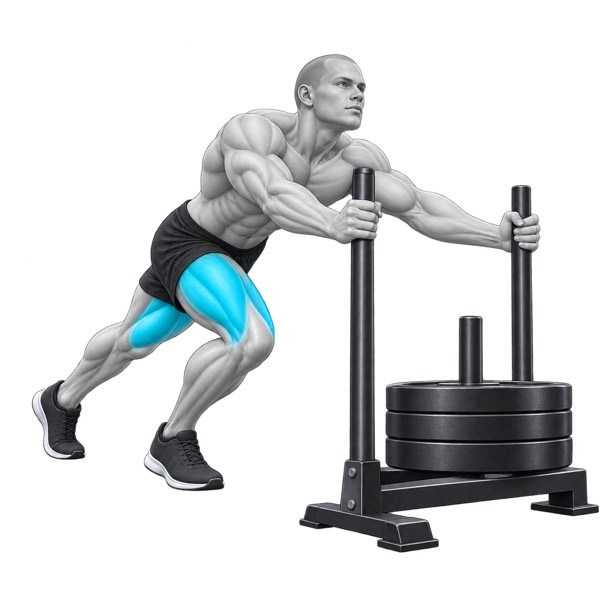
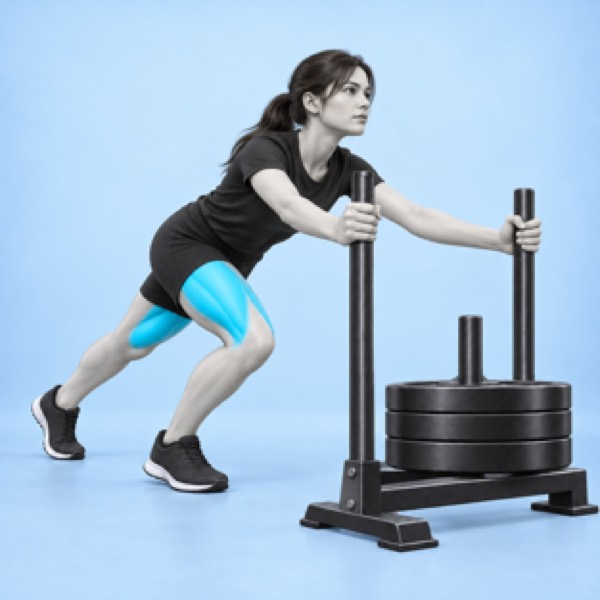
The sled push means driving a plate-loaded sled across the floor by its upright poles. It mainly works your quads, along with your glutes and calves, while your core keeps your body rigid. It builds leg drive, power and work capacity, and it's one of the HYROX stations. Many gyms call the sled a prowler.
- Primary muscle
- Quads
- Also works
- Glutes, Calves, Core
- Equipment
- Functional
- Pattern
- Conditioning
Muscles worked
On every step, your quads straighten your knee and your glutes extend the hip of the pushing leg. Your calves work hard because you drive through the balls of your feet. Your abs and lower back transfer force into the sled without your spine bending, and your shoulders, chest and triceps hold the arm position isometrically. Low handles put your body nearly horizontal and make the push harder; high handles keep you more upright, which suits slow, heavy pushes.
How to do it
Setup
- Load the sled and stand behind it with your hands on the poles.
- Lean forward to about 45°, body in a straight line from your head to your back heel.
- Lock your arm position: straight arms on the low grip, elbows bent and tucked on the high grip.
Execution
- Drive through the balls of your feet with short, fast steps.
- Fully extend your back leg on each step before bringing it forward.
- Keep your hips level with your shoulders or slightly lower, eyes on the floor a few yards ahead.
- Don't stop until the end of the lane: getting the sled moving again costs far more than keeping it going.
Key cue: Keep a sustainable pace and clean technique.
Common mistakes
- Loading so much the sled moves in jerks. Your position breaks down and every step gets short. Strip weight until you can push without stopping.
- Hips higher than your shoulders. Your back rounds and your legs lose drive. Drop your hips and find the straight line.
- Bending your arms mid-push. The force leaks out at your elbows. Lock your arms in one position and let your legs do the work.
- Long strides landing on your heels. You brake the sled on every step. Take short steps on the balls of your feet.
Variations
- Heavy march: High handles, heavy load, slow and steady steps over 10–15 yards. Builds leg strength with very little soreness.
- Light sprint: Low handles and a load you can run with over 10–20 yards. Trains acceleration and power.
- Backward drag: Using a harness or handles, walk backward pulling the sled. It loads your quads heavily and most knees tolerate it well.
Sets and reps
Program it by distance: 4–6 heavy pushes of 10–20 yards for strength, or 20–30 yards with lighter loads and short rests for conditioning. For time or distance: 3–4 rounds. Once you finish every round with good form, add load, distance or difficulty.
Alternatives
Frequently asked questions
What muscles does the sled push work?
Your quads, glutes and calves, which move the sled on every step. Your core keeps your body rigid, and your shoulders, chest and triceps hold your arm position.
Why doesn't the sled push make you sore?
It's almost all concentric: you push and there's no lowering phase to control. Soreness comes mostly from the eccentric part of a lift, so you can add sled work at the end of leg day or on an easy day and still recover fast.
How much weight should you put on the sled?
It depends heavily on the floor: the same load glides on rubber and feels far heavier on turf. Pick a weight you can push the whole lane without stopping, and note the surface so you can compare sessions.