 Zerolimits
Smith machine hip thrust
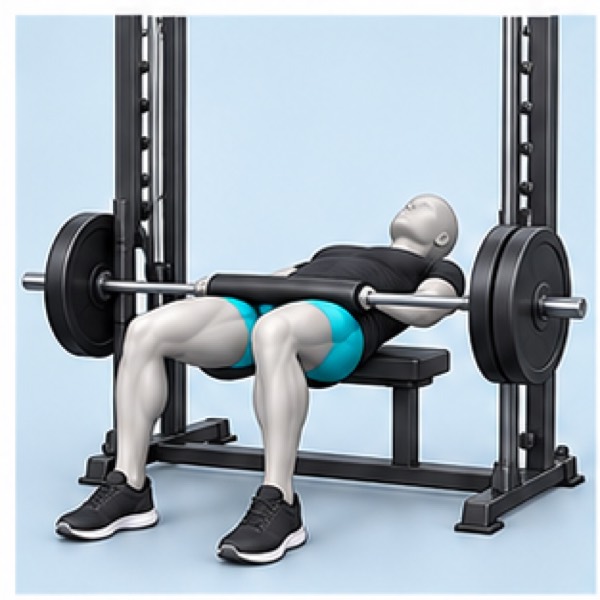
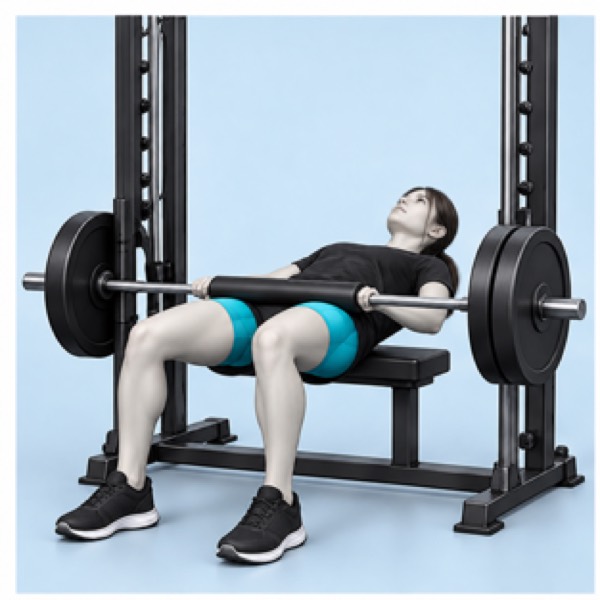
The Smith machine hip thrust is a hip thrust with the bar running on the guide rails of a Smith machine. It mainly works your glute max, with help from your hamstrings and quads, and it's easier to set up than a barbell hip thrust because there's nothing to balance.
- Primary muscle
- Glutes
- Also works
- Hamstrings
- Equipment
- Machine
- Pattern
- Hip extension
Muscles worked
Your glute max extends your hips and does most of the work, with peak tension at the top. Your hamstrings and adductor magnus assist and your quads hold your knee position. Since the bar can't drift, your stabilizers work less than with a free barbell. With your feet further out, your hamstrings work more; closer in, your quads do.
How to do it
Setup
- Place a flat bench perpendicular to the machine so that, with your back on it, the bar sits right over the crease of your hips.
- Set the safety stops slightly below the bar's lowest point.
- Pad the bar and rest your upper back on the bench edge, just below your shoulder blades.
- Plant your feet hip-width apart, far enough out that your shins are vertical at the top.
Execution
- Brace your abs, tuck your chin and unhook the bar by rotating it with your wrists.
- Drive through your heels and lift your hips until your torso is parallel to the floor.
- Squeeze your glutes for a second at the top without arching your lower back.
- Lower under control almost to the stops and drive up again; at the end, rotate the bar to rack it.
Key cue: Drive through the hips without overextending your back.
Common mistakes
- Bench in the wrong spot. If the bar lands on your stomach or thighs, move the bench before loading; the bar should travel straight over your hips.
- Skipping the safety stops. If you fail, the bar has nowhere to go; always set them slightly below your lowest position.
- Arching at the top. Keep your eyes forward and ribs down; the rep ends when your hips are extended.
- Feet too far or too close. Too far loads your hamstrings; too close lifts your heels. Adjust until your shins are vertical at the top.
Variations
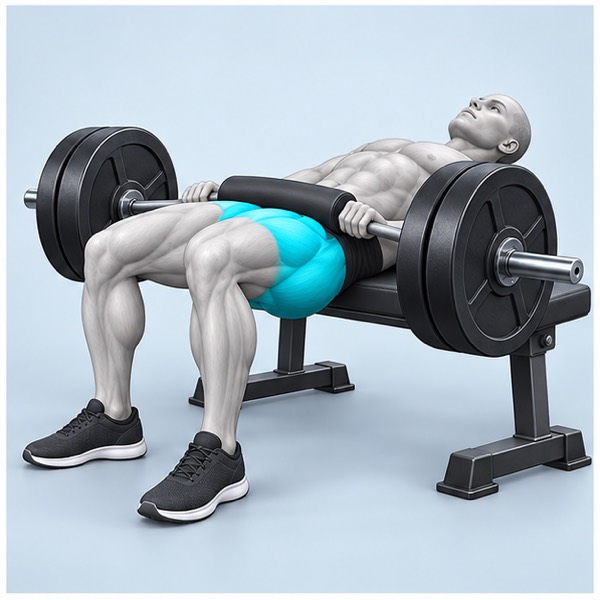
- Barbell hip thrust: A free bar has to be stabilized and takes longer to set up, but it follows the natural arc of your hips.
- Single-leg Smith hip thrust: One leg in the air with the bar across your hips. Trains each glute separately with the machine's stability.
- Banded Smith hip thrust: A mini band above your knees makes your glute medius work to keep them apart as you drive up.
Sets and reps
Because it's stable and has safety stops, it suits sets of 8–12 taken close to failure. To build muscle and strength: 6–12 reps, 3–4 sets. When you complete the range on every set, add a little weight. That's double progression.
Alternatives
Frequently asked questions
What muscles does the Smith machine hip thrust work?
Mainly your glute max, with peak tension at the top. Your hamstrings, adductor magnus and quads assist, and your abs keep your pelvis locked in place as you drive up.
Smith machine vs barbell hip thrust: which is better?
They train the same muscle with the same mechanics. The Smith version sets up faster, needs no balancing and the stops let you push close to failure safely. The free bar follows your hips' natural arc and doesn't depend on a machine.
How do you set up a bench for a Smith machine hip thrust?
Put it perpendicular to the bar, at a distance where the bar lands right on your hip crease. Test with an empty bar first and make sure it travels without hitting your stomach or rolling onto your thighs.