 Zerolimits
Machine shoulder press
The machine shoulder press is a seated overhead press on a guided machine, and it mainly works your front delts and triceps. The machine sets the path and the back pad supports you, so you can push close to failure without worrying about balance. It's also called the seated shoulder press machine.
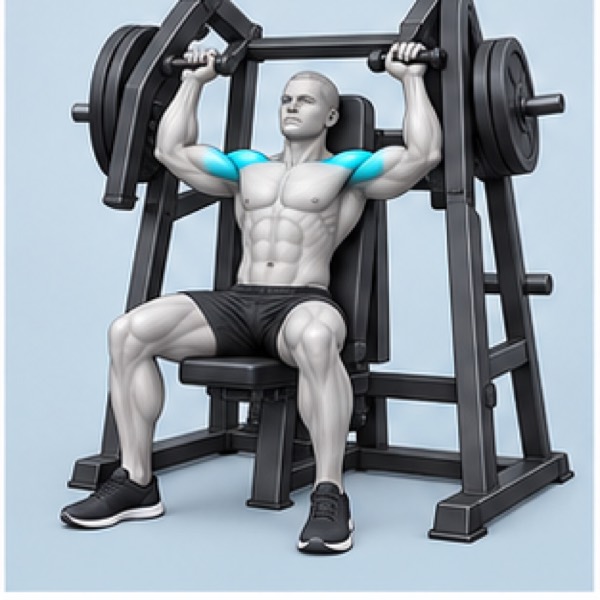
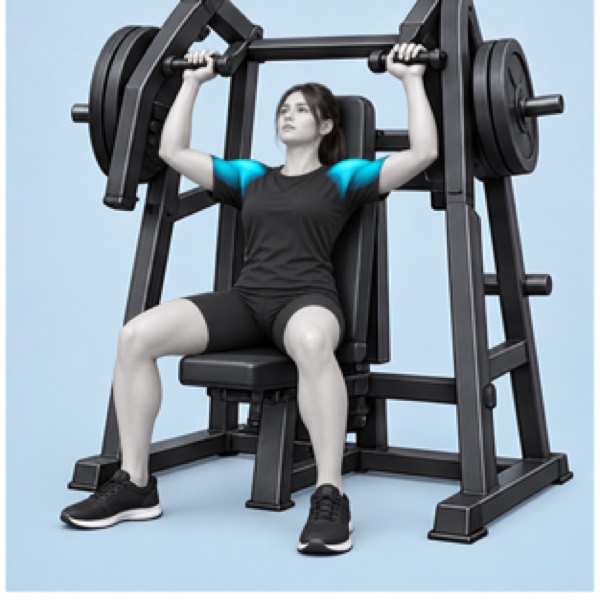
- Primary muscle
- Shoulders
- Also works
- Triceps
- Equipment
- Machine
- Pattern
- Vertical press
Muscles worked
Your front delts do most of the work and your triceps straighten your elbows near the top. Your side delts help more when your elbows point out to the sides with an overhand grip; with a neutral grip your elbows come forward and the front delts take more of the load. Your upper traps and serratus anterior assist at the top. With the pad supporting you, your core does far less than in a standing overhead press.
How to do it
Setup
- Set the seat so the handles start at about shoulder height.
- Sit with your back and head against the pad and your feet flat on the floor.
- Pick your grip: neutral, palms facing each other, or overhand, palms forward. Keep your wrists straight and stacked over your elbows.
Execution
- Brace your abs and press the handles up until your arms are almost straight.
- Keep your back on the pad and your shoulders away from your ears as you press.
- Lower under control, over about 2 seconds, until the handles are back at shoulder height.
- Start the next rep before the weight stack touches down.
Key cue: Keep your back against the pad and don't let the stack rest between reps.
Common mistakes
- Setting the seat wrong. Too high and you start too deep, which strains your shoulders; too low and you only get half the range. Adjust it until the handles start at shoulder height.
- Arching off the back pad. It turns the lift into an incline press for your chest. If you can't keep your back on the pad, the weight is too heavy.
- Doing half reps with a heavy stack. Lowering only a few inches skips the hardest part. Drop the weight and bring the handles back to shoulder height every rep.
- Shrugging from the start. Your traps take over. Set your shoulders down before the first rep and keep them there until the top.
Variations
- Single-arm machine press: Press with one arm while the other rests. Useful if one shoulder is stronger and you want to focus on each side.
- Plate-loaded converging press: The arms move independently and come together at the top, like a dumbbell press. Each side has to move its own share.
- Smith machine shoulder press: The bar runs on fixed rails. Use a bench with an upright back and set it so the bar comes down just in front of your face.
Sets and reps
Since the machine is stable, you can safely train close to failure: sets of 8–12 reps with 1–2 reps in reserve work well. To build muscle and strength: 6–12 reps, 3–4 sets. When you complete the range on every set, add a little weight. That's double progression.
Alternatives
Frequently asked questions
What muscles does the machine shoulder press work?
Mainly your front delts and triceps. Your side delts help, more with an overhand grip and flared elbows, and your upper traps assist at the top of the press.
Machine shoulder press vs dumbbell shoulder press: which is better?
Dumbbells train more stabilizers and let each arm move freely. The machine lets you push close to failure with no risk of losing the weight, and your progress is easier to track. Both build your shoulders.
Neutral or overhand grip on the shoulder press machine?
A neutral grip brings your elbows forward and is usually easier on cranky shoulders. An overhand grip flares your elbows out and gives your side delts a bit more work. Use whichever lets you press without discomfort.