 Zerolimits
Sumo deadlift
The sumo deadlift is a barbell deadlift with a wide stance and your hands inside your legs. It mainly works your glutes, with a lot of help from your quads, adductors and back, and it keeps your torso more upright than a conventional deadlift.
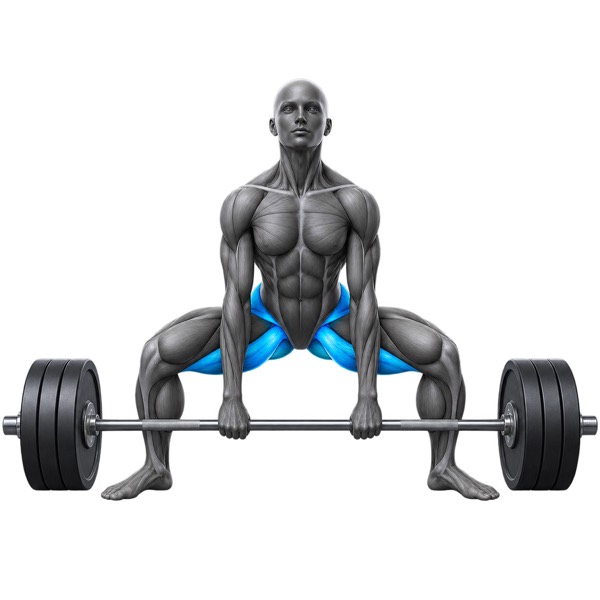
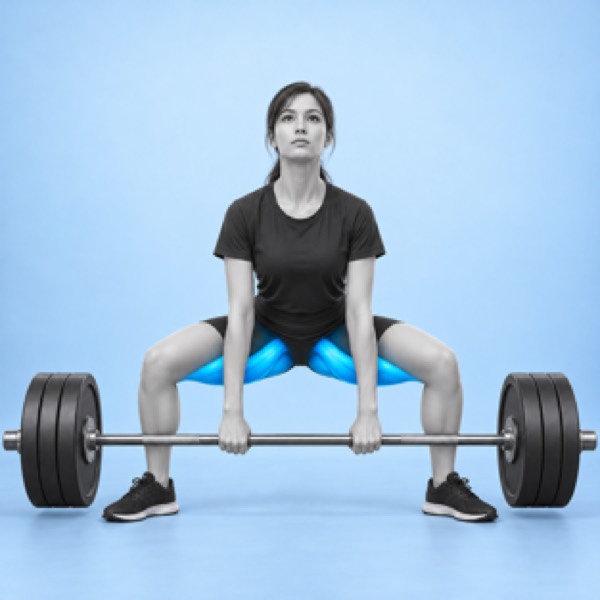
- Primary muscle
- Glutes
- Also works
- Quads, Adductors, Back
- Equipment
- Barbell
- Pattern
- Hip hinge
Muscles worked
Your glutes extend your hips and, with your glute medius, keep your knees pushed out. Your adductors, especially the adductor magnus, work harder than in a conventional pull because of the wide stance. Your quads break the bar off the floor and your hamstrings help extend your hips. Your spinal erectors, traps and lats hold your back and keep the bar close. The wider your stance, the more adductors and the shorter the range.
How to do it
Setup
- Take a stance well outside shoulder-width, toes turned out about 30–45°, and walk your shins in until the bar sits over mid-foot.
- Drop your hips and grip the bar inside your legs, shoulder-width or a bit narrower, arms vertical.
- Lift your chest, push your knees out in line with your toes and tighten your lats as if bending the bar around your legs.
Execution
- Pull gently until the bar clicks against the plates and your whole body is tight.
- Push the floor down and spread it apart with your feet, keeping your knees out.
- Drag the bar up your legs, with your hips and shoulders rising together.
- Lock out by driving your hips forward, without leaning your shoulders back.
- Lower by pushing your hips back first; once the bar passes your knees, bend them and set it down.
Key cue: Spread the floor with your feet and keep your knees pushed out over your toes.
Common mistakes
- Hips shooting up before the bar moves. It turns into a stiff-legged pull and loads your back; start with your hips a bit lower and push with your legs.
- Knees caving in. You lose the advantage of the wide stance; point your knees where your toes point and spread the floor.
- Yanking the bar off the floor. Your arms bend and your back rounds; build tension first, then push.
Variations
- Conventional deadlift: Feet hip-width and hands outside your legs. Longer range, more hamstrings and back, less adductors.
- Kettlebell or dumbbell sumo deadlift: Hold one weight between your legs. Good for learning the stance or training at home.
- Paused sumo deadlift: Pause for 1–2 seconds just after the bar leaves the floor. It fixes the habit of letting your hips rise early.
Sets and reps
For strength, sets of 3–6; to build muscle, 6–10 is plenty, since past that your back and grip give out before your legs. To build muscle and strength: 6–12 reps, 3–4 sets. When you complete the range on every set, add a little weight. That's double progression.
Alternatives
Frequently asked questions
What muscles does the sumo deadlift work?
Your glutes, quads and adductors, especially the adductor magnus. Your hamstrings help extend your hips, and your back, traps and grip hold the bar through the whole lift.
Sumo vs conventional deadlift: which is better?
Neither is better for everyone. Sumo keeps your torso more upright, shortens the range and uses more quads and adductors; conventional loads your back and hamstrings more. Try both and keep the one you can lift more with good form.
Is the sumo deadlift cheating?
No. It's legal in powerlifting meets and takes different technique, not less. The range is shorter, but breaking the bar off the floor is usually harder and it demands a lot of hip mobility.
How wide should your sumo stance be?
Wide enough that your shins are close to vertical, seen from the front and the side, when you grip the bar. If you can't get down with a neutral back, bring your feet in: wider isn't better without the hip mobility.