 Zerolimits
Turkish get-up
The Turkish get-up takes you from lying on the floor to standing, and back down, with a kettlebell held overhead on a straight arm. It mainly works your shoulder stability and core, plus your glutes and legs. It's slow, technical and trains your whole body at once.
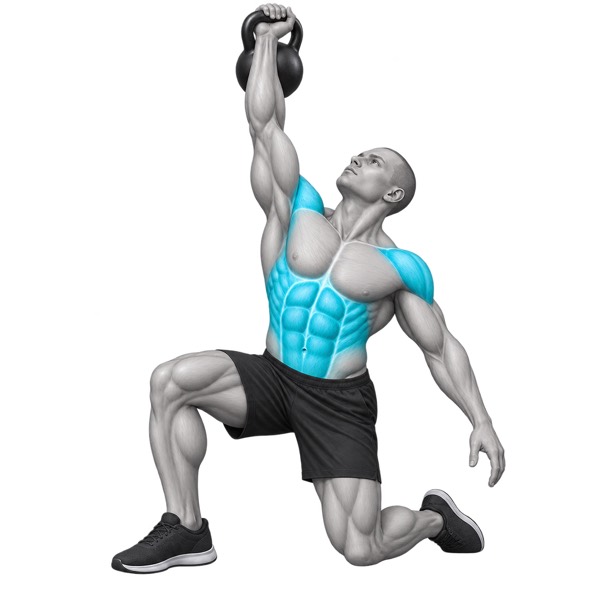
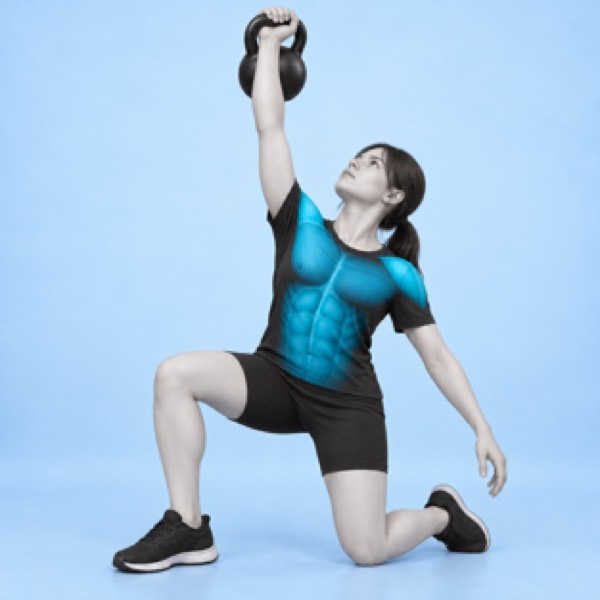
- Primary muscle
- Shoulders
- Also works
- Core, Glutes
- Equipment
- Kettlebell
- Pattern
- Shoulder and core stability
Muscles worked
Your rotator cuff, delts and serratus anterior keep the kettlebell steady overhead the whole way, and your triceps keeps your elbow locked. Your obliques and abs sit you up from the floor to your elbow and then your hand. Your glutes drive the hip bridge and, with your quads, stand you up out of the lunge. The shoulder of your support arm works too, because it holds your bodyweight on the floor.
How to do it
Setup
- Lie on your side with the kettlebell in front of your chest. Grab it with both hands and roll onto your back holding it close.
- Press it up with both hands until your right arm is straight. Never lift it off or lower it to the floor with one arm.
- Bend your right knee with your foot flat, and leave your left arm and leg straight on the floor, about 45° out from your body.
Execution
- Drive through your right foot and roll up onto your left elbow, then straighten that arm until you're on your hand.
- Lift your hips into a bridge and sweep your left leg under you until your knee is on the floor, under your hip and in line with your support hand.
- Take your hand off the floor, bring your torso upright, and swing your back leg around into a half-kneeling lunge with your knees lined up.
- Stand up by driving through your front foot, kettlebell overhead and arm locked.
- Reverse the same steps under control until you're back on the floor. Switch sides.
Key cue: Keep your arm locked and your eyes on the bell until you're standing.
Common mistakes
- Bending the top elbow. The kettlebell drifts toward your face. If you can't keep the arm locked at every step, the bell is too heavy.
- Letting your shoulder creep up toward your ear. Keep it down and packed, with your shoulder blade pressed against your ribs.
- Rushing through the steps. Each transition is a position with a short pause; if you use momentum, you lose control of the bell.
- Bridging too low. Without hip height there's no room to sweep your leg through, so you drag it. Squeeze your glute before the sweep.
Variations
- Half get-up: Go only to your hand or to the bridge, then back down. It teaches the first half, which is the most technical part.
- Shoe get-up: Do the full movement without weight, balancing a shoe on your closed fist. If it falls, your arm has left vertical.
Sets and reps
Train it with few, slow reps: 1–3 per side per round, or 5–10 minute blocks alternating sides. For time or distance: 3–4 rounds. Once you finish every round with good form, add load, distance or difficulty.
Alternatives
Frequently asked questions
What muscles does the Turkish get-up work?
Mainly your shoulder stabilizers, rotator cuff, delts and serratus, and your core. Your glutes, quads and triceps work too, with the triceps keeping your elbow locked overhead.
How heavy should a Turkish get-up be?
Learn it first with no weight or a shoe on your fist. Then use a light kettlebell, roughly 15–25 lb depending on your level, until every transition feels automatic. Go heavier only if your arm stays vertical at every step.
What is the Turkish get-up good for?
It builds loaded shoulder stability, hip mobility and full-body coordination. Light, it makes a good warm-up; heavier, it can be a main lift on a general strength day.